Strength Training for Perimenopause and Menopause: What Changes and What Actually Helps
Your scale might not move during perimenopause, but your body is changing underneath it. Here's what the research says lifting does about it, and how to start.
By Coach John · November 17, 2026
AI Disclaimer
We used AI to help write this blog. We use AI to help us write to get as much information to you as possible. All blogs are reviewed and edited by our team for accuracy. Any blog WITHOUT this disclaimer was written fully by our team with no AI assistance.
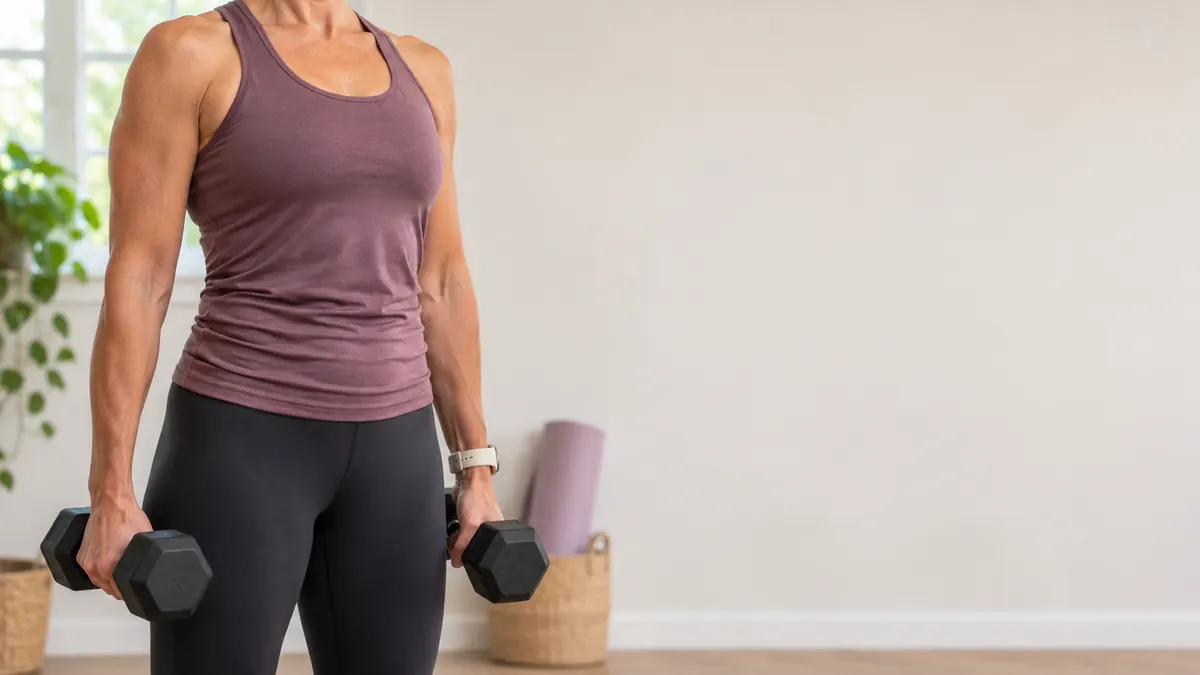
Let's say you're 47 and your weight is within a couple of pounds of where it's been for the last ten years. Your jeans fit differently, the stairs feel a little steeper than they used to, and you keep waking up at 3 a.m. for no reason you can name. You'd be forgiven for thinking you're imagining it, because the scale insists nothing has happened. But the scale is measuring the wrong thing, and what's going on underneath it is one of the best arguments there is for picking up something heavy.
What perimenopause actually is
Perimenopause is the stretch of years before your periods stop for good, when estrogen and progesterone start rising and falling unpredictably instead of following their usual monthly pattern. The U.S. Office on Women's Health says it usually starts in your mid-to-late 40s. Menopause itself is just one day on the calendar, the point twelve months after your last period, and in the United States it arrives at an average age of 52. The National Institute on Aging says the whole transition usually takes about seven years and can stretch to fourteen, so this isn't something you wait out over a long weekend.
Hot flashes, poor sleep, mood swings and brain fog get most of the attention, and for good reason, since they're the parts you can feel. The changes I care about most as a coach are the ones you can't feel until they've been happening for a while.
The changes the scale doesn't show
The best data on perimenopause comes from SWAN, the Study of Women's Health Across the Nation, which has followed more than 3,000 American women through midlife since the 1990s. In a 2019 paper in JCI Insight, its researchers measured body composition with DEXA scans and found that once the menopause transition begins, the rate at which women gain fat doubles while their lean mass starts to decline, and both trends continue until about two years after the final period. The strange part is that body weight didn't speed up at all, because the fat being added roughly cancels out the muscle being lost. That's exactly why so many women say they haven't gained a pound and still nothing fits.
Bone follows the same calendar. In an earlier SWAN paper in the Journal of Bone and Mineral Research, women lost an average of about 7.4% of their bone density in the lower spine and 5.8% at the top of the thigh bone, right where hip fractures happen, over the window from roughly one year before their final period to two years after it. Three years is a short time to lose that much, and it's a big reason osteoporosis is so much more common in women. We've covered that side of it in more detail in our post on osteoporosis and strength training.
None of this is a reason to panic. It's a reason to give your body a job that makes it want to hold on to its muscle and bone, and nothing does that better than lifting.
What lifting does about it
It can build bone, not just slow the loss
For years the standard advice for women with low bone density was to stick to light weights and walking, out of fear that anything heavier would cause a fracture. The LIFTMOR trial at Griffith University in Australia tested that fear head on. It took 101 postmenopausal women with low bone mass, average age 65, and had half of them do two supervised 30-minute sessions a week of deadlifts, back squats, overhead presses and jumping chin-ups with a firm landing, working up to five sets of five at more than 80 to 85% of their max.
After eight months that group had gained 2.9% bone density in the spine while the women doing a light home program lost 1.2%. At the hip, the heavy group held steady while the home group lost 1.9%, and the only injury reported in the whole study was one minor back spasm. Those women were coached and built up to the heavy loads gradually, so the lesson isn't to walk into a gym and deadlift your bodyweight on day one. The lesson is that bone responds to being loaded, and light weights forever probably won't load it enough.
Strength training helps keep the muscle you have
Muscle plays by the same rule as bone. If it's asked to do hard work through strength training on a regular basis, your body keeps it, and if it isn't, your body treats it as an expensive luxury it can quietly let go of. Walking is wonderful for your heart and your mood, but it isn't heavy enough to convince your legs they need to stay strong, which is why it can't do the job that lifting does. If you're new to the idea, our beginner's guide to strength training walks through the basics.
It may even help with hot flashes
This one surprised a lot of people, researchers included. In a 2019 trial published in Maturitas, a team at Linköping University in Sweden put postmenopausal women with frequent moderate-to-severe hot flashes through 15 weeks of supervised resistance training, and their hot flashes dropped by roughly half compared with a group that didn't train. The benefit was still there six months after the program ended, but it had faded by the two-year follow-up, which is a polite way of saying the training only works while you keep doing it.
Sure, lifting won't replace hormone therapy for someone whose symptoms are severe, and that's a conversation to have with your doctor. But no prescription will make you stronger on its own, so the two work best together.
What a week of training should look like
You don't need to train every day, and you definitely don't need to live at the gym. Assuming your doctor has cleared you to exercise, here's what I'd want to see in a week for almost any woman at this stage of life.
Lift two or three days a week. Each session should work your whole body with a handful of big movements: a squat, a hinge like a deadlift or a Romanian deadlift, a press, a row and a carry. Two days is enough to make real progress, and three is better if your recovery and your schedule allow it.
Make it heavy enough to count. By the last couple of reps of each set, the weight should feel genuinely hard while your form stays clean. Trying to strengthen your bones with three-pound pink dumbbells is like trying to get a tan with a flashlight, so once a weight feels easy for every rep, it's time to go up.
Add a little impact if your joints allow it. Bone responds to impact as well as load, which is why LIFTMOR included those jumping chin-ups. That doesn't mean box jumps on day one; small hops, step-downs and short skips are plenty to start with.
Keep your walking and cardio, but build it around the lifting. Cardio is great for your heart, and it pairs well with strength work, but it can't stand in for it.
Write down what you lift. If you don't know what you did last week, you can't make sure you do a little more this week, and that slow, steady increase is where most of the results come from.
Adjust on the bad nights. When sleep falls apart, which happens a lot in perimenopause, train a little lighter that day instead of skipping it. A lighter session still sends the signal, and you'll be back to full weights when you feel like yourself again.
Eat enough protein to build muscle with
Lifting sends the signal and protein supplies the building materials, and plenty of women eat less of it than they think, especially once they start eating lighter to manage their weight. An international expert group called PROT-AGE recommends that adults over 65 get at least 1.0 to 1.2 grams of protein per kilogram of body weight a day, and at least 1.2 grams if they exercise. That's well above the 0.8 grams in the official recommended dietary allowance. Those numbers were written for older adults, but I think the same logic applies once lean mass starts slipping in your late 40s.
For a 150-pound woman, 1.2 grams per kilogram works out to roughly 80 grams a day. Splitting that into three meals of 25 to 30 grams is far easier than trying to catch up at dinner, and these five high-protein meals are a good place to start. If you have kidney disease, check with your doctor before raising your protein.
Is it too late to strength train if you're already past menopause?
No. The women in LIFTMOR averaged 65 and had already been diagnosed with low bone mass, and they still built bone. The best time to start lifting was before perimenopause began, and the second-best time is this week. If you're older still, our post on starting at 60 or 70 answers that question directly, and if you're also on a GLP-1 medication, this guide to lifting on GLP-1s covers how to protect your muscle while the weight comes off.
Training through perimenopause and menopause in Naples
At Galaxy Fit Lab, our private studio in North Naples, most of the people we train are over fifty. Every client gets a program written for them, adjusted around their joints, their sleep and whatever else life is throwing at them that week, and every set is tracked so the weights go up on purpose instead of by accident. You can see what it costs on our pricing page, and the first consultation is free.
The scale might not notice any of this for years. Your muscles and bones notice right away, and they'll be glad you started now.
This article is educational and isn't medical advice. Talk to your doctor before starting a new exercise program, especially if you've been diagnosed with osteoporosis or have other health conditions.